Showing posts with label Mozart. Show all posts

Tuesday, June 21, 2022

Horszowski, Katims, Schneider, Miller Play Mozart and Beethoven


New York Quartet
Horszowski, Katims, Schneider, Miller
Play Mozart and Beethoven

This lovely performance from 1953 of these two works does not seem to have made it to CD, though it is digitized in the internet archive, where one can also find the text from the back of the LP jacket. As musicological information about the works can be found elsewhere, I don't have much to add. I found the LP only recently, cleaned it, played it, liked it, and after finding it unrepresented on CD, decided to digitize and clean up the record and post it. Flac and mp3 files, along with cd cover art for those who still enjoy burning to a format that is not so gradually disappearing, can be found here: https://www.mediafire.com/folder/w3w6v8exjkki4/Horszowski_Katims_Schneidr_Miller_Mozart_Beethoven

I hope you enjoy the music and performances as much as I do. Schneider and Horszowski are two of my favorite musicians.


Sunday, January 16, 2011

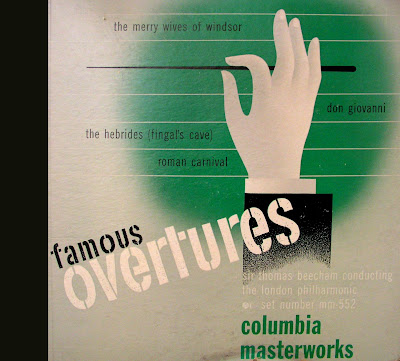
Beecham conducts Favorite Overtures (LPO)


First off, my thanks to jsserraglio for fixing the picture above. The original post included an image with serious barrel distortion that he fixed and sent back to me. I appreciate it a lot.

I have had these two overtures ready for some time, but got stuck on the third of the fourth in the 78rpm set, Mendelssohn's Hebrides Overture, which is in fairly poor shape. Having been absent from posting for so long, I have decided to put up the two that are done and to add the other two, including The Merry Wives of Windsor, at a later date, if and when I can bring them into decent sonic shape.

These pieces are all readily available in recordings with Beecham made with the Royal Philharmonic. I love his RPO recordings, but his London Philharmonic records have always had a very special place in my affections, and he is a conductor about whom I am a completest; I want every recording he ever made. He was my first "favorite", and although I no longer describe my response to artists in those limiting terms, my regard for his music-making has only grown through the years. The musical world is richer for his recordings of Sibelius, Mozart, Haydn, and for the few opera recordings that have come down to us. Would there were more. His recording of the Mendelssohn Reformation Symphony is still my favorite after all these years, his LPO recordings of Mozart are peerless, his Delius (a composer I like a lot) set the standard. His sometimes mordant wit, known in countless retellings, has sometimes made him more famous for what he said than for the sterling performances passed down to us in recordings.

He introduced Richard Strauss to England, and the live performance of his Elektra with Paul Schoeffler, Elisabeth Höngen, Ljuba Welitsch, and Erna Schlüter in the title role, is a chilling account of murder, and the psychological cost of vengeance. But despite his important achievements in music of great seriousness and profundity, he is best known to many for his "Lollipops" --- overtures and light fare, which, in fact, nobody did better. Listen to his recorded RPO performance of the "La Gazza Ladra" overture; it is pure genius.

So, while I will continue to work on the other two overtures of this set as time allows, I just did not want to wait any further to post the Mozart Don Giovanni and Berlioz's Roman Carnival. Enjoy!


Links to all files

Friday, June 25, 2010

Menuhin, Kenter, Cassado play Ravel Trio / Mozart Trio


For me, this is THE recording of the Ravel trio. It is played with a refinement and palette of tonal color that one rarely encounters in any music, and is a pure pleasure to hear. The instrumentalist's understanding of each other results in a performance that is profoundly controlled, in spite of an overarching sense of improvisational abandon, and beautifully phrased throughout. It is an effort between musical peers with deep sympathy for each other, for the score, and for the arts of instrumental color. After all these years, nothing has replaced it in my affections.

Link to all files

Monday, March 8, 2010

Mozart Concerti with A. Schneider and R. Kirkpatrick


Another great Haydn Society project from the 1950s, this one from 1951, formed around "authentique performance" notions of its time. The music-making itself, however, was informed more by musical than by questionable historical ideas, unlike so much contemporary output, and the performances are quite lovely. Ralph Kirkpatrick plays "a John Challis reproduction of the small late 18th century piano, which gives us an authentic idea lof how this music must have sounded in the composer's time." The string section is comprised of 4 first violins, 3 second violins, 3 violas, 2 cellos, and on bass.

I confess that, authentic or not, the piano here, though nicely played, makes me long for a modern instrument, and later developments in the early music trend, which eventually became a cult, leave me cold. With the exception of Makerras and some few others, contemporary "authentic" performance makes me glad the modern concert grand was developed, that string players replaced gut strings with steel ones, and that women took over treble lines from creepy counter-tenors.

In this record, though, the period piano notwithstanding, the music making is of a very high caliber. It should stand as a rebuke to those who seem to think that playing the notes in reasonable facsimiles of instruments of the time is enough.

Link to all files

Sunday, February 14, 2010

Dorati Conducts Bartok Divertimento and Mozart Symphony 31

This is apparently a relatively rare LP, a fact I discovered only when I searched online to gather information on it for this post. Having bought it in a Boston thrift store eons ago and then learned the Bartok piece from it, I have always had a great fondness for it. I developed quite early a deep and enduring love for Bartok and with that I discovered the special properties Dorati brought to the performance of his music. If there are later recordings by the same maestro with more polished orchestras and better recorded sound, nonetheless, this performance retains a visceral excitement that warrants its being better known. And the Minneapolis Symphony, graced by a series of brilliant conductors -- Ormandy, Mitropoulos, Dorati -- was an accomplished ensemble that communicated a sense of the committment of those masters to the many modern works it recorded under them. The Mozart is stylish and beautifully performed, albeit with less than ideal recorded sound. It is apparently a performance much sought after, though. The Bartok was apparently recorded in 1950 and was an original LP release (RCA LM 1750), coupled with Kodaly's Háry János Suite. This later release, LM 1185, sees it coupled with the Mozart, a recording about which I still have almost no information. Link to folder with all FLAC and MP3 files

Sunday, January 24, 2010

Casadesus Mozart Munch and Barbirolli


The recording presented here is from a record of two wonderful Mozart recordings by the incomparable Robert Casadesus. I'm posting only the Barbirolli recording, because the performance with Munch has tracking problems at the beginning of the first movement on my copy. Fortunately, however, the very useful blog Quartiers des Archives by Benoit has the missing half of this record. If you follow the link you will be able to download his posting of the Munch recording from an earlier LP release than this one.

I am nonetheless very pleased to be able to offer the Barbirolli and Casadesus recording of the 27th Concerto, K.595, from a period of Barbirolli's career that is unjustly maligned. I think you will find him a very sympathetic accompanist to the Mozartian magic of Robert Casadesus; his individual solutions here and there to certain problems of phrasing are idiomatic and charming. Anyone familiar with the great recordings of his later years will realize that he did not suddenly become a great conductor out of an artistic nadir to which some critics still consign his early career. If he grew as a musician -- and he did -- all the better. But to dismiss his New York Philharmonic period just because NY critics of the time were in a pout that he was not Toscanini, is to miss some very satisfying performances. An early recording he did of the Sibelius Second Symphony (which I unfortunately do not own) demonstrates eloquently what would later be proved beyond any doubt: he had a real genius for the great Finnish composer. He began as an accomplished musician and became a great one. One cannot really blame him for one of the many periods where the NY. Philharmonic goes to pieces, though it rises quite nicely to the occasion on this recording.
( A performance of the Sibelius 2nd symphony with the Boston Symphony Orchestra from 1964, in need of some re-equalization, can be found here: http://tinypaste.com/2d708ae)


Link to FLAC and MP3